How Unified Data Schemas Can Simplify Frontend Development for 150+ Chains
Building decentralized applications that span multiple blockchains often feels like translating a dozen different languages at once.

David Liu
Tech
10 Minutes
Building decentralized applications that span multiple blockchains often feels like translating a dozen different languages at once. The friction caused by fragmented JSON-RPC interfaces and inconsistent data structures forces engineering teams to spend more time on infrastructure "plumbing" than on core product features. By adopting unified data schemas, developers can finally abstract away these network-level differences, drastically reducing development overhead and creating a truly seamless multi-chain experience. We’ll explore how this standardized approach improves code maintainability and look at the strategic implementation paths for scaling across a fragmented ecosystem.
The Multi-Chain Reality: A Frontend Developer's Headache
The blockchain landscape is rapidly evolving, with a proliferation of new chains, each offering unique features, consensus mechanisms, and ecosystems. While this diversity fosters innovation, it also presents significant challenges for frontend developers aiming to build dApps that support multiple chains.
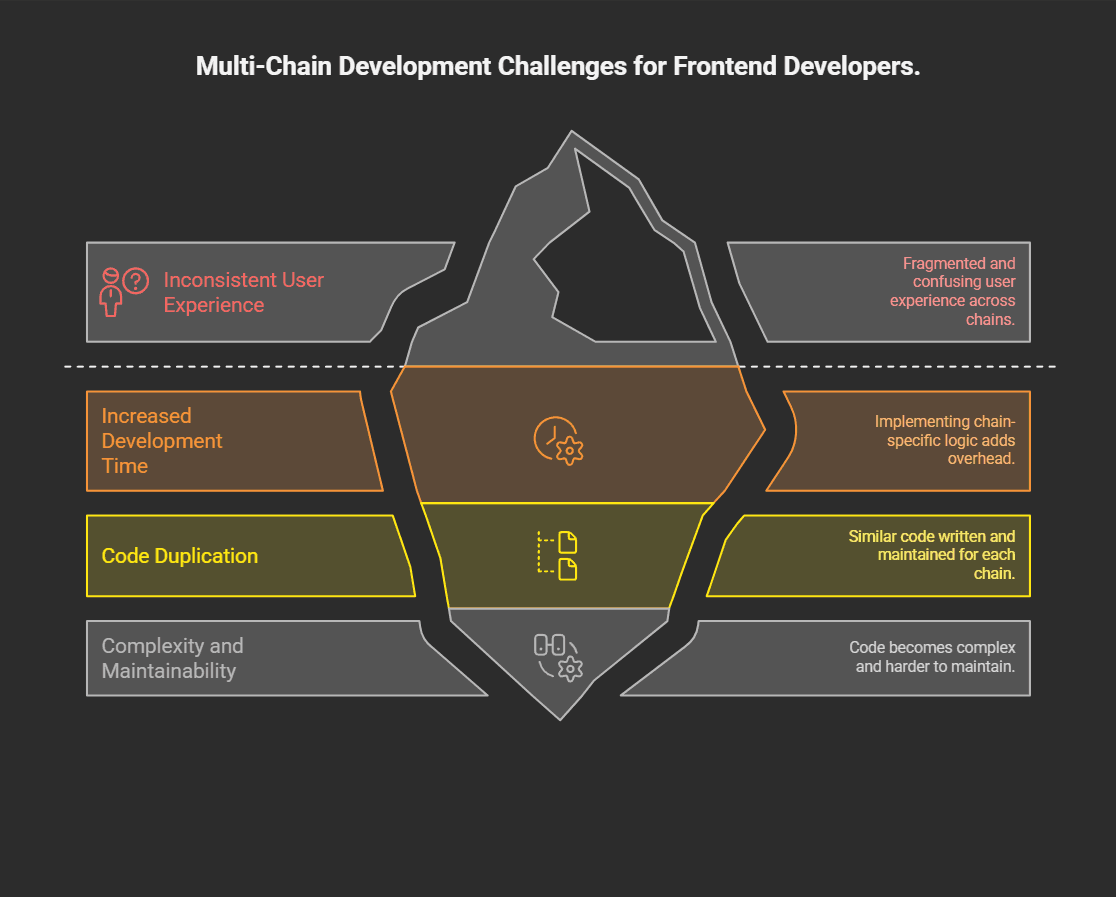
One of the most significant hurdles is the inconsistency in how different blockchains expose their data through JSON-RPC. While JSON-RPC is a widely adopted protocol for interacting with blockchain nodes, the specific methods, parameters, and data structures vary considerably across different chains. This means that a frontend developer needs to write custom code for each chain to fetch and interpret data, leading to:
Inconsistent User Experience: Differences in data presentation and interaction patterns across chains can lead to a fragmented and confusing user experience.
Increased Development Time: Implementing chain-specific logic for data fetching and parsing adds significant overhead to the development process.
Code Duplication: Similar code needs to be written and maintained for each chain, leading to code bloat and increased maintenance burden.
Complexity and Maintainability Issues: The codebase becomes more complex and harder to maintain as the number of supported chains grows.
Consider a simple example: fetching the balance of an account. On Ethereum, this might involve calling the eth_getBalance method with the account address. However, on another chain, the method name might be different, the address format might vary, or the response structure might be different. The frontend developer needs to account for all these variations, adding complexity to the application.
The Solution: Unified Data Schemas
To address these challenges, we propose a solution based on unified data schemas. The core idea is to define a set of standardized schemas that represent common blockchain data types, such as accounts, transactions, blocks, and events. These schemas act as an abstraction layer, shielding the frontend from the underlying differences in JSON-RPC interfaces and data structures.
Here's how it works:
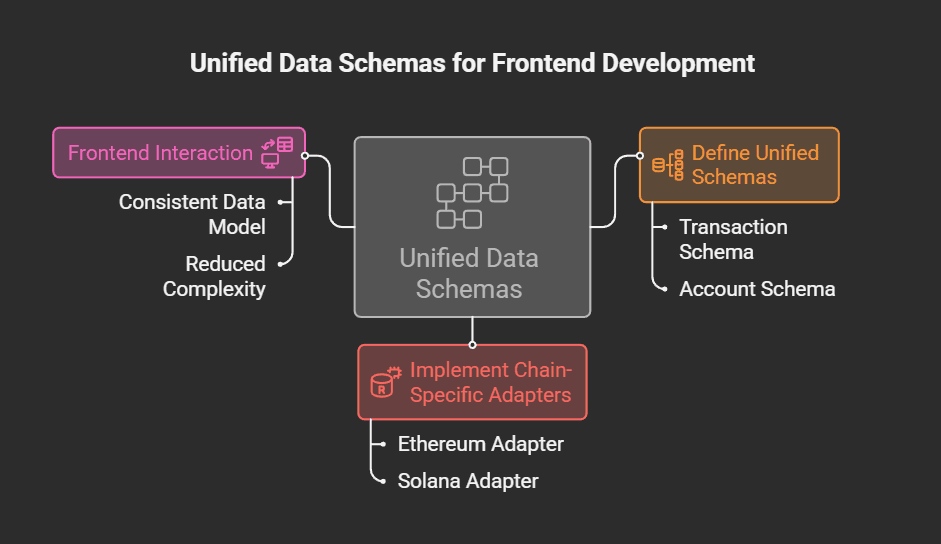
Define Unified Schemas: Create a set of standardized JSON schemas for common blockchain data types. These schemas should be designed to be generic enough to accommodate the variations across different chains, while still providing a clear and consistent representation of the data. For example, a
Transactionschema might include fields likehash,from,to,value,gas, anddata, with appropriate data types and validation rules.Implement Chain-Specific Adapters: For each supported chain, implement an adapter that translates the chain's native JSON-RPC responses into the unified data schemas. This adapter is responsible for fetching data from the chain's node, parsing the response, and mapping the data to the corresponding fields in the unified schema.
Frontend Interaction with Unified Schemas: The frontend application interacts with the unified data schemas instead of directly calling the JSON-RPC methods of each chain. This allows the frontend to work with a consistent data model, regardless of the underlying chain.
Example:
Let's say we have a unified schema for Account with fields address and balance.
Ethereum Adapter: The Ethereum adapter would call
eth_getBalanceand map the result to thebalancefield of theAccountschema. It would also ensure theaddressis in the correct format.Solana Adapter: The Solana adapter would use the Solana Web3.js library to fetch the account balance and map it to the
balancefield of theAccountschema. It would also handle any Solana-specific address formatting.Frontend: The frontend application would simply request the
Accountdata using the unified schema, without needing to know the specifics of how the data is fetched from each chain.
Benefits of Unified Data Schemas
Adopting unified data schemas offers several significant benefits for frontend development:
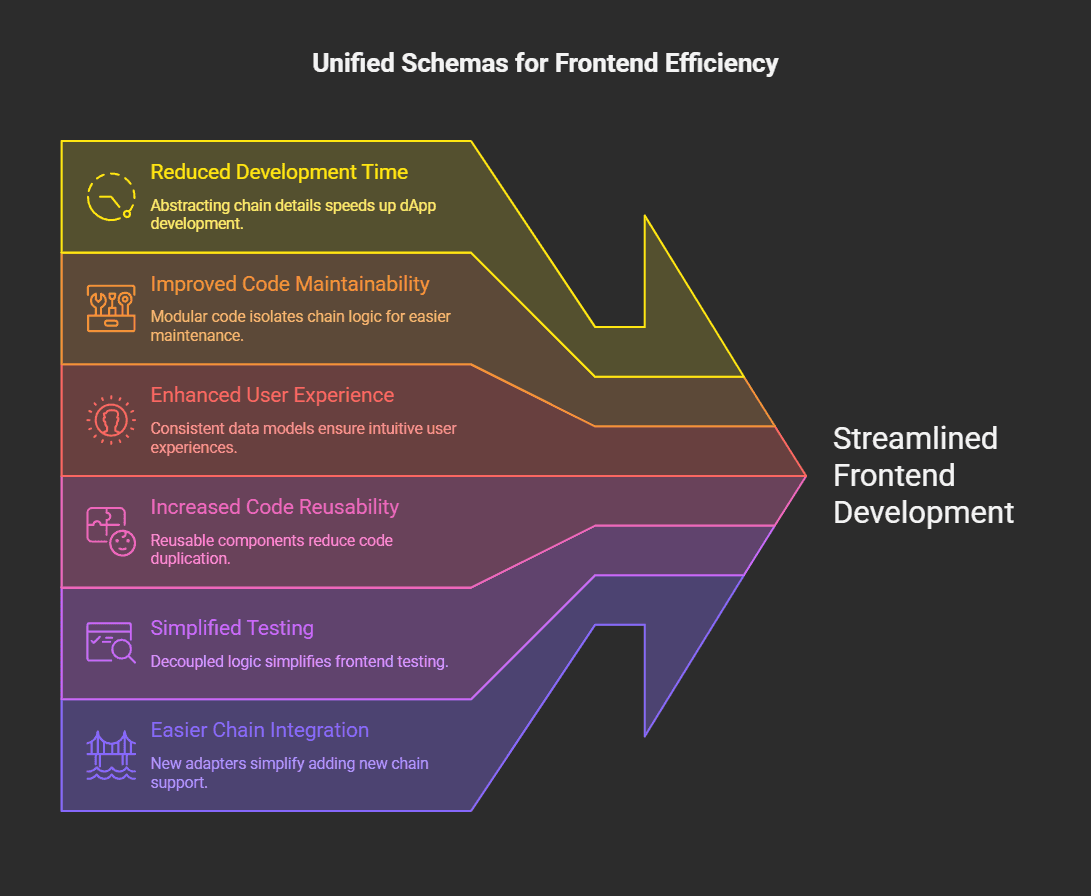
Reduced Development Time: By abstracting away the chain-specific details, developers can focus on building the core functionality of the dApp, rather than spending time on data fetching and parsing.
Improved Code Maintainability: The codebase becomes more modular and easier to maintain, as the chain-specific logic is isolated in the adapters.
Enhanced User Experience: A consistent data model ensures a more uniform and intuitive user experience across different chains.
Increased Code Reusability: Components and utilities can be built to work with the unified schemas, promoting code reuse and reducing duplication.
Simplified Testing: Testing becomes easier as the frontend logic is decoupled from the underlying chain implementations.
Easier Chain Integration: Adding support for new chains becomes simpler, as it only requires implementing a new adapter that maps the chain's data to the unified schemas.
Implementation Considerations
Implementing unified data schemas requires careful planning and consideration of several factors:
Schema Design: The schemas should be designed to be generic enough to accommodate the variations across different chains, while still providing a clear and consistent representation of the data.
Adapter Implementation: The adapters should be implemented efficiently and robustly, handling potential errors and edge cases.
Data Validation: Data validation should be performed at both the adapter and frontend levels to ensure data integrity.
Performance Optimization: Caching and other optimization techniques should be used to minimize the impact on performance.
Schema Evolution: The schemas should be designed to be extensible, allowing for future additions and modifications without breaking existing functionality.
Tooling and Libraries: Consider using existing libraries and tools for schema validation, data transformation, and API generation.
Potential Technologies and Frameworks
Several technologies and frameworks can be used to implement unified data schemas:
JSON Schema: A widely adopted standard for defining the structure and validation rules for JSON data.
GraphQL: A query language for APIs that allows clients to request specific data fields, reducing over-fetching and improving performance.
TypeScript: A statically typed superset of JavaScript that can be used to define and enforce the data types of the unified schemas.
React/Vue/Angular: Popular frontend frameworks that can be used to build dApps that interact with the unified data schemas.
Web3 Libraries (e.g., ethers.js, web3.js): Libraries that provide access to blockchain nodes and allow for interacting with smart contracts.
Conclusion
Unified data schemas offer a powerful solution for simplifying frontend development in the multi-chain world. By abstracting away the complexities of different JSON-RPC interfaces and data structures, they enable developers to build dApps that support multiple chains with greater ease, efficiency, and maintainability. As the blockchain landscape continues to evolve, adopting unified data schemas will become increasingly crucial for building seamless and user-friendly multi-chain experiences. This approach not only benefits developers but also contributes to a more unified and accessible blockchain ecosystem for users.
Build Multi-Chain Applications with Uniblock.dev
The blockchain ecosystem is fragmented. Your infrastructure shouldn't be.
Managing multiple provider integrations, inconsistent data formats, and chain-specific implementations consumes engineering resources that should be spent on product development. Developers who can abstract away this complexity and deliver seamless multi-chain experiences have a distinct advantage.
Uniblock.dev provides unified blockchain infrastructure for production applications. Whether you're:
Building dApps that span multiple chains
Implementing consistent data schemas across providers
Managing JSON-RPC complexity at scale
Developing DeFi protocols that need reliable cross-chain data
...Uniblock.dev handles routing, normalization, and failover so your team can focus on building.
Why Uniblock.dev
Unified Data Layer – Consistent response formats across 300+ blockchains and providers
Centrally Managed Routing – Traffic is already routed to the best available provider
Built-In Reliability – Redundancy and failover are handled before outages reach your application
Operational Transparency – Request logs, provider states, and queue depths visible in real-time
Human Accountability – Engineers on call when things go wrong
Start Building Today
The multi-chain complexity exists. We manage it.
Visit Uniblock.dev and access your API keys
Review our documentation for implementation guides
Join our Discord community to connect with engineers building at scale