A Comparative Analysis of Consensus Algorithms: PoW, PoS, and Beyond
Consensus algorithms are the backbone of decentralized systems, enabling agreement on a single version of truth across a distributed network.

David Liu
Blockchain
10 Minutes
Introduction to Consensus Algorithms
Consensus algorithms are the backbone of decentralized systems, enabling agreement on a single version of truth across a distributed network. In the context of blockchain technology, they are crucial for validating transactions and adding new blocks to the chain, ensuring security, integrity, and immutability. Without a central authority, these algorithms allow nodes in the network to collectively decide which transactions are legitimate and in what order they should be recorded.
Proof-of-Work (PoW)
Mechanism
Proof-of-Work (PoW) was the first widely adopted consensus algorithm, popularized by Bitcoin. In PoW, miners compete to solve a complex cryptographic puzzle. The first miner to find a solution broadcasts it to the network, along with the proposed block of transactions. Other nodes then verify the solution. If the solution is valid, the block is added to the blockchain, and the miner receives a reward (newly minted cryptocurrency and transaction fees). The difficulty of the puzzle is adjusted periodically to maintain a consistent block creation time.
Advantages
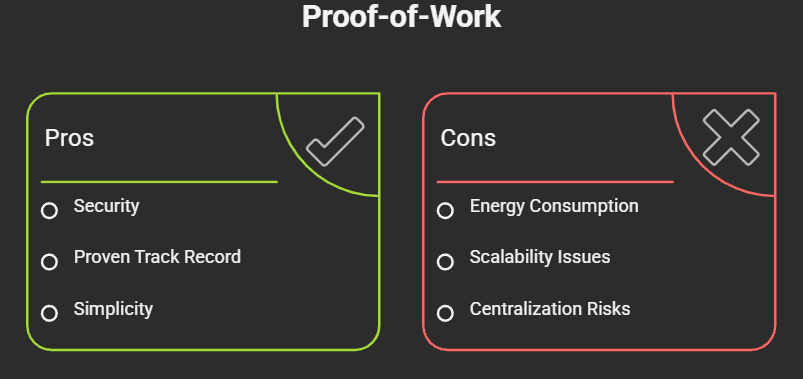
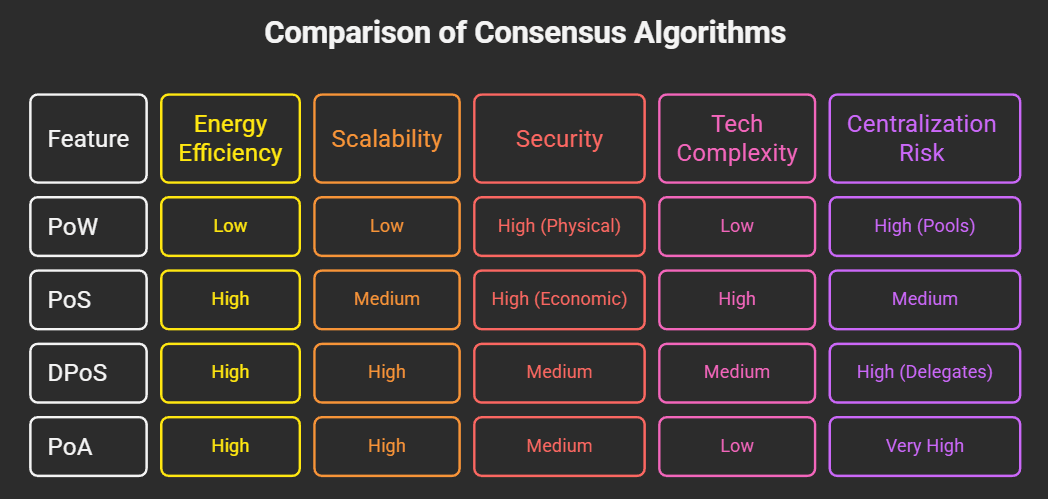
Security: PoW is considered highly secure due to the computational power required to attack the network. A malicious actor would need to control more than 50% of the network's hashing power (a 51% attack) to successfully manipulate the blockchain.
Proven Track Record: Bitcoin's long history and resilience demonstrate the robustness of PoW in a real-world, high-stakes environment.
Simplicity: The core concept of PoW is relatively straightforward to understand and implement.
Disadvantages
Energy Consumption: PoW is notoriously energy-intensive, as miners expend significant electricity in their attempts to solve the cryptographic puzzle. This has raised environmental concerns and questions about the sustainability of PoW-based blockchains.
Scalability Issues: PoW blockchains often suffer from scalability limitations due to the time required to solve the puzzle and validate blocks. This can lead to slow transaction speeds and high transaction fees.
Centralization Risks: The high cost of mining equipment and electricity can lead to centralization, where a few large mining pools control a significant portion of the network's hashing power
Proof-of-Stake (PoS)
Mechanism
Proof-of-Stake (PoS) offers an alternative to PoW that aims to address its energy consumption and scalability issues. In PoS, validators are chosen to create new blocks based on the amount of cryptocurrency they "stake" or hold in the network. The more stake a validator has, the higher their chance of being selected to propose a new block. Validators earn rewards for validating transactions and adding blocks to the blockchain.
Advantages
Energy Efficiency: PoS is significantly more energy-efficient than PoW, as it does not require validators to expend vast amounts of computational power.
Scalability: PoS can potentially offer better scalability than PoW, as block creation is not limited by the time required to solve a complex puzzle.
Reduced Centralization Risks: PoS can be designed to be more resistant to centralization than PoW, as it does not require specialized hardware or access to cheap electricity.
Disadvantages
Fork Problem: In some PoS implementations, validators may have an incentive to validate multiple forks of the blockchain, as they do not risk losing their stake in the event of a fork. This can weaken the security of the network.
Wealth Concentration: PoS can potentially lead to wealth concentration, as validators with large stakes are more likely to be chosen to create new blocks and earn rewards.
Complexity: PoS implementations can be more complex than PoW, requiring careful design to address potential vulnerabilities and ensure fairness.
Delegated Proof-of-Stake (DPoS)
Mechanism
Delegated Proof-of-Stake (DPoS) is often described as a digital democracy. Instead of every node competing to validate blocks, token holders use their stake to vote for a small, fixed number of "delegates" (also called witnesses or block producers). These elected delegates are responsible for reaching consensus, validating transactions, and maintaining the ledger. If a delegate fails to perform their duties or acts maliciously, stakeholders can vote them out and replace them with a new candidate.
Advantages
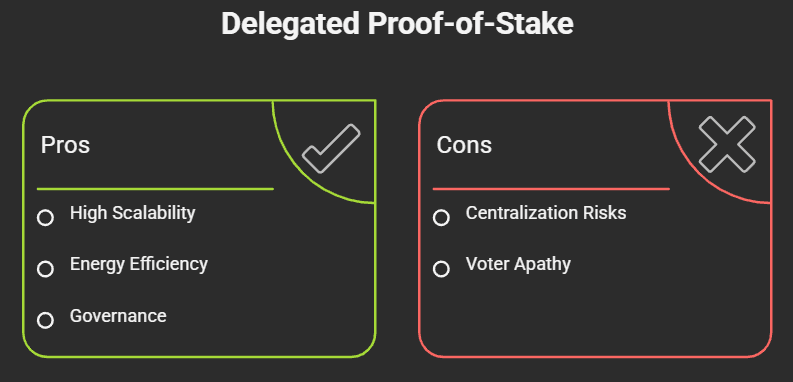
High Scalability: By limiting the number of validators (often to 21 or 101), DPoS can process transactions much faster than PoW or standard PoS, achieving very high throughput.
Energy Efficiency: Like standard PoS, it requires negligible electricity compared to the massive computational requirements of mining.
Governance: The voting system provides a clear framework for network upgrades and community-led decision-making.
Disadvantages
Centralization Risks: Because only a small group of delegates produces blocks, the network is more centralized than other systems.
Voter Apathy: If a small percentage of token holders participate in voting, a few "whales" can effectively control the entire network.
Proof-of-Authority (PoA)
Mechanism
Proof-of-Authority (PoA) relies on the value of identities rather than the value of coins or computational power. In this system, validators are not anonymous; they are pre-approved entities that have undergone a rigorous vetting process. To earn the right to validate blocks, an individual or organization must prove their identity and maintain a good reputation. Because the validators’ real-world identities are at stake, they are incentivized to act honestly to avoid legal or professional repercussions.
Advantages
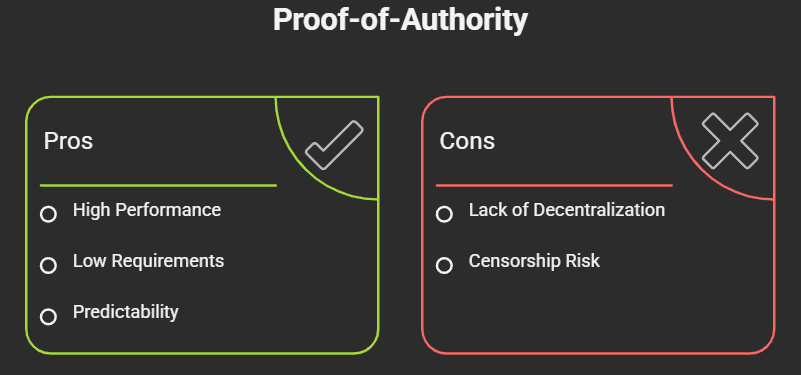
High Performance: PoA is highly efficient and scalable, making it ideal for private or permissioned enterprise blockchains.
Low Requirements: It requires very little computational power and no specialized hardware to maintain the network.
Predictability: Blocks are generated at consistent intervals by known, reliable participants.
Disadvantages
Lack of Decentralization: PoA is generally not suitable for public, permissionless blockchains because it relies on a centralized authority to vet and appoint validators.
Censorship Risk: Since the identities of all validators are known, they may be more susceptible to external pressure or government intervention.
Practical Byzantine Fault Tolerance (PBFT)
Mechanism
PBFT is an algorithm designed to settle transactions even when some nodes in the network are "Byzantine" (malicious or failing). In PBFT, all nodes are in constant communication. One node is designated as the "Leader," while others are "Backups." A transaction goes through a three-phase process: Pre-prepare, Prepare, and Commit. For a block to be finalized, more than two-thirds of all nodes must agree on its validity. As long as at least $2/3$ of the nodes are honest, the network maintains its integrity.
Advantages
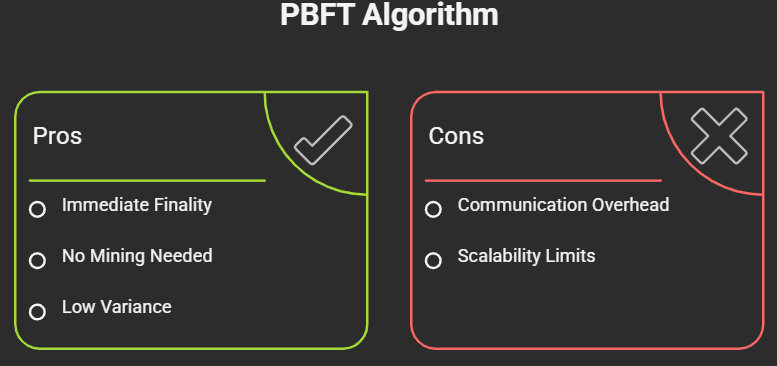
Immediate Finality: Unlike PoW, where you must wait for several "confirmations," PBFT transactions are final the moment they are added to the block.
No Mining Needed: There is no need for energy-intensive computation or high-powered hardware.
Low Variance: The time taken to reach consensus is relatively stable.
Disadvantages
Communication Overhead: As the number of nodes increases, the amount of messaging between them grows exponentially ($O(n^2)$), which limits the network's size.
Scalability Limits: Due to the heavy communication requirements, PBFT is difficult to scale to thousands of nodes, making it better for smaller, permissioned networks.
Proof-of-Elapsed-Time (PoET)
Mechanism
Developed primarily by Intel, PoET is a "lottery-based" consensus mechanism often used in permissioned blockchains like Hyperledger Sawtooth. It mimics the "waiting" aspect of PoW but without the energy waste. Every node requests a wait time from a "Trusted Execution Environment" (TEE), such as Intel SGX. This secure enclave generates a random wait time and ensures the node actually waits for that duration. The node with the shortest wait time "wakes up" first and wins the right to forge the next block.
Advantages
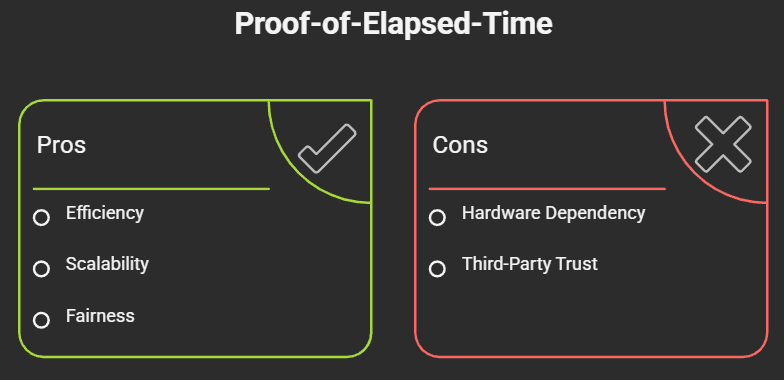
Efficiency: PoET achieves the fairness of PoW’s lottery system without requiring any significant electricity or specialized mining rigs.
Scalability: It can scale to thousands of nodes because the communication overhead is much lower than in PBFT-style systems.
Fairness: The TEE ensures that every participant has an equal chance of winning based on the randomly assigned timer.
Disadvantages
Hardware Dependency: PoET requires specific hardware (processors with TEE support), which creates a dependency on manufacturers like Intel.
Third-Party Trust: You must trust that the hardware manufacturer has not built "backdoors" into the secure enclave that could compromise the randomness.
Conclusion
The choice of consensus algorithm depends on the specific requirements of the blockchain application. PoW offers strong security but suffers from high energy consumption and scalability issues. PoS provides a more energy-efficient and scalable alternative, but it requires careful design to address potential vulnerabilities. Other consensus algorithms, such as DPoS, PoA, PBFT, and PoET, offer different trade-offs between security, scalability, and efficiency. As blockchain technology continues to evolve, we can expect to see further innovation in consensus algorithms, leading to more efficient, secure, and scalable decentralized systems.