.svg)
The Hidden Cost of "Free" RPCs

David Liu
.png)
Relying on "free" or public RPC endpoints is a classic case of hidden technical debt. While a $0 price tag is enticing on a spreadsheet, the actual cost is paid in engineering hours spent managing aggressive rate limits, building complex failover logic, and babysitting node health.
This deep dive uncovers the true Total Cost of Ownership (TCO) behind public infrastructure and benchmarks it against the operational efficiency of a dedicated RPC orchestration layer. By shifting the burden of infrastructure maintenance to an abstraction layer, engineering teams can stop fighting "plumbing" issues and refocus on shipping core features that move the needle.
The Allure of "Free" RPCs
The blockchain ecosystem thrives on accessibility. Public RPC endpoints provide a seemingly straightforward entry point for developers to interact with various blockchain networks. These endpoints, often offered by node operators or community initiatives, appear to eliminate the immediate financial barrier to entry. This is especially attractive for early-stage projects, hobbyists, and developers experimenting with new concepts. The initial setup is simple: grab an endpoint URL, plug it into your code, and start making requests.
The Reality Bites: Hidden Engineering Costs
However, the simplicity is deceptive. The "free" in "free RPC" often translates to a significant investment of engineering time and resources dedicated to mitigating the inherent limitations and unreliability of these services.
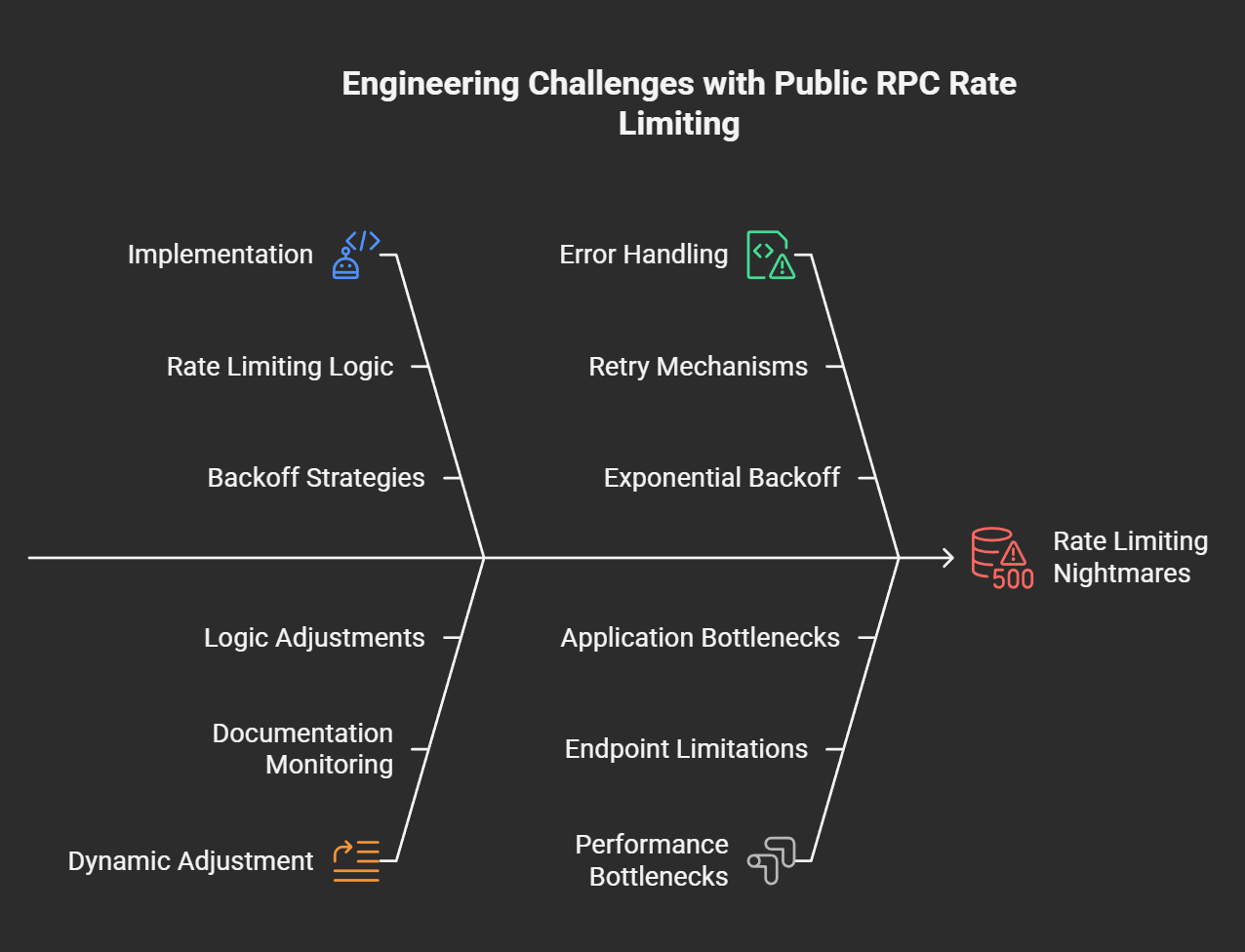
1. Rate Limiting Nightmares
Public RPC endpoints are shared resources. To prevent abuse and ensure availability for all users, they are typically subject to strict rate limits. These limits dictate the maximum number of requests a user can make within a specific timeframe. Exceeding these limits results in request rejections, leading to application downtime and a degraded user experience.
Engineering Implications:
- Implementation of Rate Limiting Logic: Developers must implement sophisticated rate limiting logic within their applications to avoid exceeding the RPC provider's limits. This involves tracking request counts, implementing backoff strategies, and potentially queuing requests for later execution.
- Dynamic Adjustment: Rate limits can change without notice. Engineers need to constantly monitor the RPC provider's documentation and adjust their application's rate limiting logic accordingly. This requires ongoing maintenance and vigilance.
- Error Handling and Retries: Robust error handling is crucial to gracefully manage rate limit errors. This includes implementing retry mechanisms with exponential backoff to avoid overwhelming the RPC endpoint.
- Performance Bottlenecks: Even with careful rate limiting, applications can still experience performance bottlenecks due to the inherent limitations of the public RPC endpoint.
2. The Failover Fiasco
Public RPC endpoints are not guaranteed to be available 24/7. Node operators may experience downtime due to maintenance, hardware failures, or network issues. Relying on a single public RPC endpoint creates a single point of failure, making applications vulnerable to outages.
Engineering Implications:
- Implementation of Failover Mechanisms: Developers must implement failover mechanisms to automatically switch to a backup RPC endpoint when the primary endpoint becomes unavailable. This requires maintaining a list of alternative endpoints and implementing logic to detect and respond to failures.
- Endpoint Monitoring: Continuous monitoring of RPC endpoint availability is essential to proactively detect and respond to outages. This requires implementing monitoring tools and setting up alerts to notify engineers of potential problems.
- Data Consistency Challenges: Switching between RPC endpoints can introduce data consistency challenges, especially if the endpoints are not perfectly synchronized. Developers need to implement strategies to ensure data integrity and avoid inconsistencies.
- Increased Complexity: Implementing robust failover mechanisms adds significant complexity to the application's architecture and increases the maintenance burden.

3. Node Maintenance Headaches
Public RPC endpoints are backed by blockchain nodes that require ongoing maintenance. This includes software updates, security patches, and hardware upgrades. These maintenance activities can lead to temporary downtime or performance degradation, impacting application availability and performance.
Engineering Implications:
- Lack of Control: Developers have no control over the maintenance schedule of public RPC endpoints. This makes it difficult to plan for downtime and coordinate application updates.
- Unpredictable Performance: Node maintenance can lead to unpredictable performance fluctuations, making it difficult to optimize application performance.
- Security Risks: Relying on public RPC endpoints exposes applications to potential security risks if the node operators fail to implement proper security measures.
- Limited Support: Public RPC endpoint providers typically offer limited support, making it difficult to troubleshoot issues and resolve problems quickly.

The Orchestration Layer Solution: A Worthwhile Investment
An RPC orchestration layer, such as Uniblock, provides a managed and reliable alternative to typical RPC endpoints. These services abstract away the complexities of managing rate limits, implementing failover mechanisms, and handling node maintenance.
Benefits of Using an Orchestration Layer:
- Simplified Development: Orchestration layers provide a unified API that simplifies blockchain interactions and reduces the amount of code required to interact with different blockchain networks.
- Scalability and Reliability: Orchestration layers are designed to handle high volumes of requests and provide guaranteed uptime, ensuring application availability and performance.
- Rate Limit Management: Orchestration layers automatically manage rate limits, eliminating the need for developers to implement complex rate limiting logic within their applications.
- Failover and Redundancy: Orchestration layers provide built-in failover and redundancy, ensuring that applications remain available even if individual nodes experience downtime.
- Node Maintenance and Security: Orchestration layers handle node maintenance and security, freeing up developers to focus on building their applications.
- Dedicated Support: Orchestration layers typically offer dedicated support, providing developers with access to expert assistance when needed.
Quantifying the Cost Savings
While orchestration layers come with a cost, the savings in engineering time and resources can often outweigh the financial investment. Consider the following:
- Reduced Development Time: The simplified API and managed infrastructure of orchestration layers can significantly reduce development time.
- Lower Maintenance Costs: Orchestration layers eliminate the need for developers to manage rate limits, implement failover mechanisms, and handle node maintenance, reducing ongoing maintenance costs.
- Improved Application Performance: The scalability and reliability of orchestration layers can improve application performance and user experience.
- Reduced Downtime: The built-in failover and redundancy of orchestration layers can minimize downtime and prevent revenue loss.
By carefully considering the hidden costs of "free" RPCs and the benefits of using an orchestration layer, developers can make informed decisions that optimize their development process, improve application performance, and reduce overall costs. The initial investment in a robust orchestration layer often proves to be a more sustainable and cost-effective solution in the long run.
Stop Paying the Hidden Tax on Free RPCs
Rate limits, failover logic, node health checks - none of this is your problem to solve.
Every hour your engineers spend managing RPC reliability is an hour not spent shipping. The public endpoint that looks free on a spreadsheet is running a tab in your eng org: retry logic to maintain, monitoring to babysit, failover paths to rebuild every time a node goes dark.
Uniblock manages the infrastructure layer so the tab closes.
What's already handled:
- Auto-routing across 300+ chains and providers - traffic reaches the best available node without application-side logic
- Failover runs before outages surface to your stack
- Rate limit management centralized, not distributed across individual codebases
- Request logs, provider states, and latency visible in real-time - not estimated
The RPC complexity in this post exists in every production blockchain application. Uniblock is where it gets absorbed.
Get your API key at uniblock.dev
Review the documentation
Related posts